
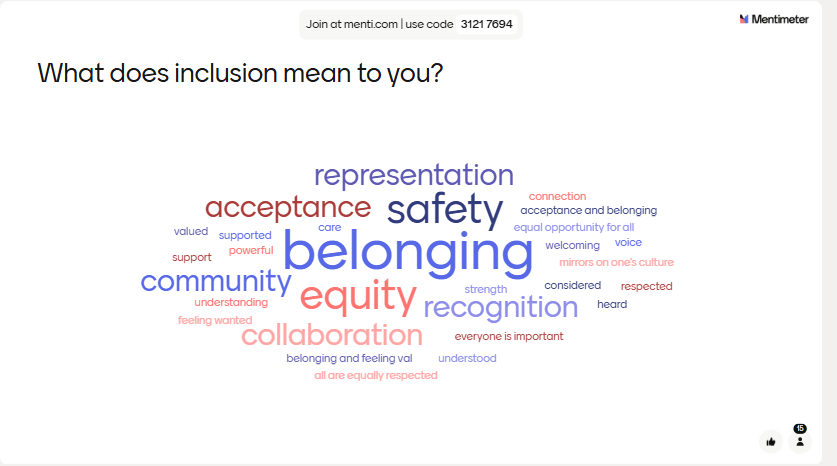
Earlier this week, I had the privilege of leading a Heddle EAL Masterclass on Inclusion in the Mainstream Classroom. We began with a simple yet powerful question:
What does inclusion mean to you?
Participants’ responses created a word cloud filled with terms such as belonging, acceptance, safety, community, and representation. For me, this was a reminder that inclusion is not just a buzzword, it is both deeply human and deeply practical.
Defining Inclusion for Multilingual Learners
Inclusion is about more than placing multilingual learners in mainstream classrooms. As The Bell Foundation (2020) explains, it means
adapting systems and classroom practice to support multilingual learners, rather than expecting them to simply “fit in.”
UNESCO (2009) adds that
inclusion involves being proactive in identifying barriers and finding the resources to remove them.
For multilingual learners, this can mean anything from ensuring the correct pronunciation of names, valuing their home languages, to designing lessons that make space for translanguaging.
Why Inclusion Matters
Inclusion isn’t only about equity for multilingual learners. It benefits the whole school community:
- 🌍 Identity & belonging: Students feel seen and valued when their language and culture are recognised.
- 🤝 Social cohesion: Inclusive classrooms build empathy, reduce exclusion, and strengthen relationships.
- 📈 Better learning: Strategies designed for multilingual learners (like scaffolding and visuals) often make lessons clearer for everyone.
- 🌐 Global readiness: Schools that embrace multilingualism prepare students for an interconnected world.
The Four Dimensions of Inclusion
Drawing on Evans et al. (2020) and The Bell Foundation (2024), we explored four key dimensions:
- Academic inclusion – Multilingual learners are fully engaged in curriculum learning.
- Linguistic inclusion – All of a learner’s languages are valued as tools for learning.
- Social inclusion – Learners and families feel accepted and comfortable in the school community.
- Teacher attitudes – Staff view multilingual learners as assets, not challenges.
Practical Strategies
During the webinar, we shared and discussed examples of everyday practices that bring inclusion to life:
- Academic inclusion: scaffolding lessons with visuals and word banks, providing glossaries, and highlighting key vocabulary.
- Linguistic inclusion: structured translanguaging activities that allow learners to process content in more than one language.
- Social inclusion: making the effort to pronounce students’ names correctly, creating a Language Ambassadors programme, or celebrating a Language of the Month.
- Family inclusion: ensuring parents have access to information in accessible languages, offering ESOL classes, or involving families in school events.
Reflecting on Current Practice
To close the session, participants reflected on three simple steps:
- Reflect on current practice – What are we already doing well?
- Identify opportunities for growth – Where are the gaps?
- Set next steps – What is one concrete change we can make right now?
This reflective process ensures that inclusion doesn’t remain an abstract value, but becomes a series of actionable commitments.
Moving Forward
The energy and ideas in this Masterclass reminded me of the power educators hold to create classrooms of real belonging. When schools adapt systems and attitudes to truly value multilingual learners, everyone benefits.
👉 If you’d like to explore these themes further, I share resources and reflections regularly here at Every Language Learner.
💡 For more structured professional learning opportunities, follow the Heddle EAL Community page, a space for collaboration, reflection, and practical strategies to make multilingual inclusion a reality.

Leave a comment