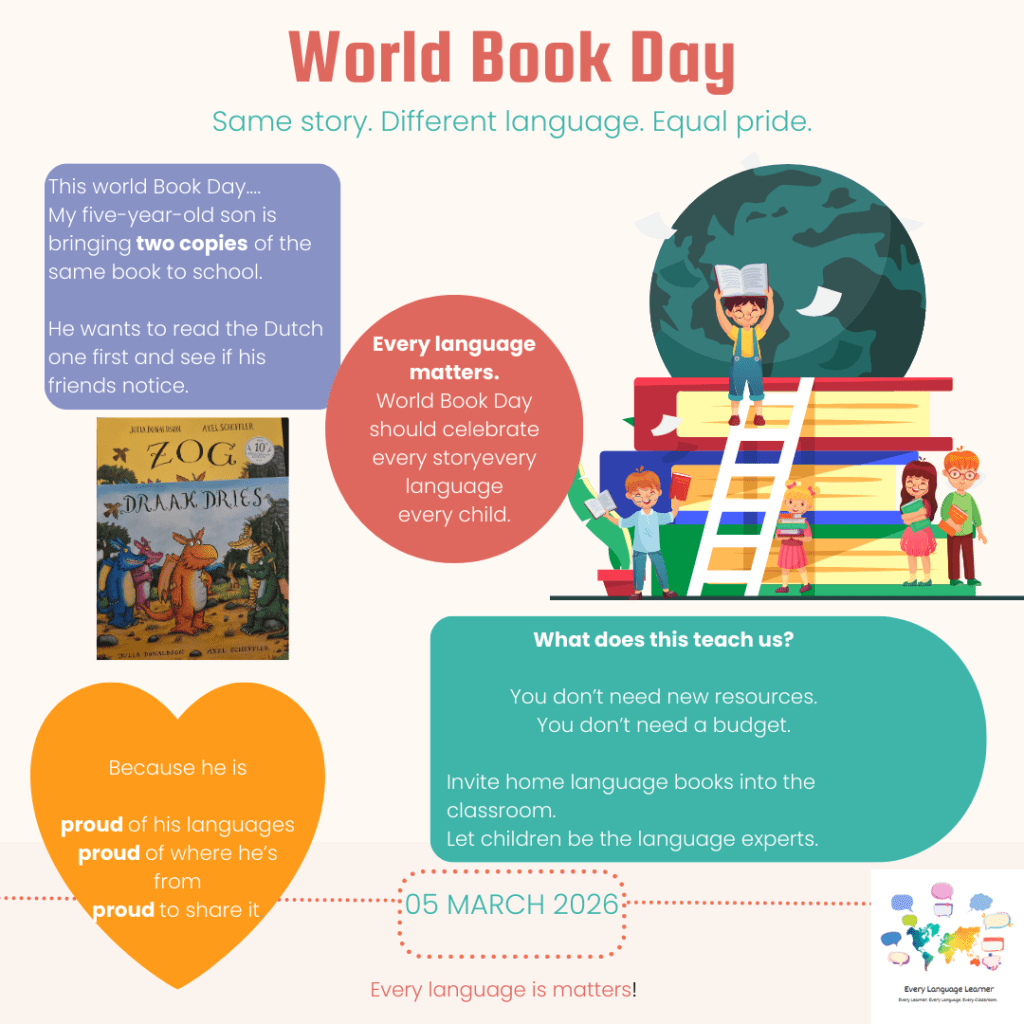
This World Book Day, my five-year-old son is taking two copies of the same book to school.
One is Zog.
The other is Draak Dries, the Dutch version.
His plan?
Read the Dutch one first and see if his friends notice.
Not because he wants to confuse them.
Because he is proud.
Proud of his language.
Proud of where he’s from.
Proud to share it.
And in that small, joyful act is a powerful reminder for all of us in education.
Familiar stories, new languages
One of the easiest ways to include multilingual learners in World Book Day is to use translations of books children already know and love.
A familiar story in a different language means:
- Children can follow the narrative through the pictures
- They recognise the characters and structure
- They stay engaged even if they don’t understand every word
It removes the fear of “not understanding” and replaces it with curiosity.
It also allows one child, the child who speaks that language, to become the expert in the room.
That shift in power is everything.
You don’t need a budget
There is a persistent myth that inclusive practice requires new resources.
It doesn’t.
You don’t need to buy dual-language libraries.
You don’t need specialist materials.
You just need to invite children to bring the texts they already have at home.
A picture book.
A comic.
A traditional story.
A religious text.
A song or rhyme.
All of these are valid forms of literacy.
All of them deserve space in our classrooms.
The moment of pride
When a child hears their home language in school, something changes.
They sit up straighter.
They smile differently.
They look around to see who else is listening.
They are no longer the learner who is “still acquiring English”.
They are the expert.
The storyteller.
The language holder.
That moment builds belonging faster than any display or policy ever could.
World Book Day is the perfect opportunity
World Book Day is already about celebrating stories.
So let’s make sure we are celebrating all of them.
This could be as simple as:
- Asking children to bring a book in their home language
- Pairing it with the English version if possible
- Letting them read a page or teach a key word
- Inviting families to come and read to the class
No timetable overhaul.
No new initiative.
Just a small, intentional shift.
Every language matters
When we only centre English texts, we unintentionally send a message about which languages, and which children, count.
When we include home languages, we send a different message:
You belong here.
Your language belongs here.
Your story belongs here.
A five-year-old carrying multiple copies of the same book should not be the exception.
It should be the norm.
Because every language matters.
And every child deserves to see their reading life reflected in school.
For School Leaders
- Invite parents and carers to read in their home language during World Book Day.
- Encourage children to bring in favourite books from home.
- Pair home-language books with English versions where possible.
- Celebrate all forms of literacy: picture books, comics, songs, folk tales, recipes, oral storytelling.
These small steps create a classroom where every child feels seen and valued.
Do you need help to draft a newsletter to parents?
This should help you along the way:
This World Book Day, we’re celebrating every story, in every language.
We’re inviting children to bring books from home in their home language, and to share a page or a favourite word with their classmates.
By making space for multilingual stories, we are showing that every language matters and that your child’s identity, family, and reading life belong in school.

Leave a comment